
In this article you can find out how:
- Learning is a way to respond to change
- Learning should be seen as part of an organisation’s “range of services” for its employees
- The 70-20-10 method should be used effectively
- The roles of front-line staff, management and employees in enabling learning should be defined
- Learning should be measured in order to be genuinely useful
On 5 November 2025, we took part in a partnership with our partner SKILLE network“Developing skills and learning in everyday life” with SKILLE’s Juhana Lamberg and our own Customer Success Manager Henna-Riikka Ahvenjärvi. Read the interesting article written on the basis of the webinar, where you can pick up practical tips for developing your own or your team’s everyday learning.
Learning at work
The world of work is changing rapidly, but an organisation’s ability to succeed ultimately depends not on a single technology or trend, but on how well the organisation learns.
Learning is not a separate training day in the calendar, but a way of approaching work:
- stopping to see what works and what doesn’t
- deliberate experimentation
- sharing insights with others
- moving forward a little better than yesterday
The core message is clear: learning happens where the work happens. It is up to the organisation to make it visible, possible and allowed.
Learning is a way to respond to change
Change is visible at many levels in organisations: structures are living, services are evolving, new tools are being introduced and customer expectations are changing.
It is no longer a question of whether changes will come, but of the capacity to respond to them.
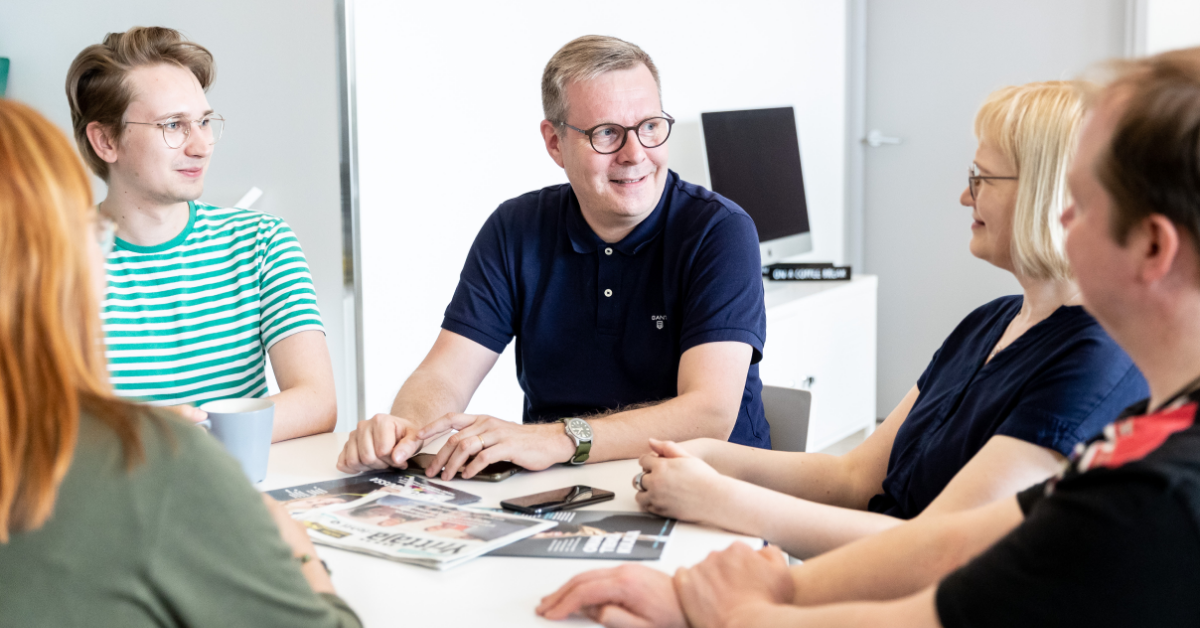
The ability to change does not happen all at once: if an organisation reacts only to isolated problems, everyday life becomes fragmented. Instead, long-term learning builds the capacity to flex and innovate in a sustainable way.
The ability to change does not happen all at once: if an organisation reacts only to isolated problems, everyday life becomes fragmented. Instead, long-term learning builds the capacity to flex and innovate in a sustainable way.
Learning as a “service provided by the organisation”
Learning should be seen as a service that an organisation provides to its employees. It helps to shift the thinking from a single course offering to a holistic approach where learning is a planned, managed and supported process.
This service is made up of four components:
1. Structures of learning
The organisation needs a common understanding of how to develop competences, where to identify learning needs, how to link them to objectives and what processes should be used to help the employee move forward in everyday life. Structure does not mean heavy bureaucracy, but clear rules of the game.
2. The Learning Service Pathway
Each employee has his or her own learning path, but the organisation can support this through induction, deepening role-specific skills, learning from change situations (new processes, systems, responsibilities) and continuous development and career paths.
Learning does not have to be a linear “first course, then work” sequence. More importantly, there should be natural places on the path to practice, reflect and seek support.
3. Facilitation and rhythm
Not everyone is an inherently self-directed super learner. That’s why it’s good for organisations to consider:
- who enables learning (management, HR, front-line staff, more experienced colleagues)
- what forums are available for discussion (team meetings, retrospectives, sparring sessions)
- how often we stop to reflect on what we have learned.
Facilitation is not just about organising events, but above all about creating a safe, learning-friendly environment.
4. Community and continuity
Individual training does not change the culture of an organisation. What does is that learning insights are shared with colleagues, teams learn together, successes and lessons learned from mistakes are made visible, and learning is part of everyday speech, not just in HR documents.
70-20-10 – a simple way to look at everyday learning
Ahvenjärvi urges organisations to use the 70-20-10 model as a practical tool to help them ask: do we have too narrow an understanding of learning?
70% – learning by doing
New responsibilities, experiments, problem solving, simulations, small development experiments, self-evaluation.
20 % – learning through interaction
Learning from colleagues, giving and receiving peer feedback, mentoring, joint development meetings, benchmarking.
10% – formal learning
Training, online courses, coaching, guidelines, articles, books.
In many organisations, it’s easy to get stuck in that 10% because it’s the easiest to measure. Ahvenjärvi challenges us to look at how to make parts 70 and 20 visible and supported.
A safe space to learn
Learning is not a siloed process. It involves uncertainty, incomplete ideas, experimentation and also failure.
It’s worth considering what happens in an organisation when someone makes a mistake – or when something goes exceptionally well? Do you just get stuck in a fix and move on in a hurry? Or do we stop and reflect together on what lessons can be learned and how they can be shared more widely?
“A safe space means not having to know everything by heart, asking questions is not a weakness, experimentation is allowed, and that mistakes are talked about in a way that benefits the whole team.”
Henna-Riikka Ahvenjärvi, Saarni Learning
The role of front-line staff and management in enabling learning
It is often assumed that frontline workers “know how to lead learning”, even though the skill does not come naturally. In frontline work, training is also needed on how to facilitate team learning, how to build space for reflection into everyday life, how to identify and articulate competency needs, and how to make it visible that learning is an expected and desired part of the job.
Leaders’ own example is crucial. When leaders talk openly about their own areas for improvement and where they want the organisation to grow, it encourages all staff to see learning opportunities in both successes and failures.
How should learning be measured?
The effects of learning are not always easy to put into numbers, but that doesn’t mean they don’t exist.
Measurement is something to think about on several levels:
What are the learning outcomes? For example, better service or product quality, fewer errors, smoother processes, passing audits, customer satisfaction.
What behaviour change is needed? What do people and the work community need to do differently to change the results?
What do you need to learn to make change possible? Knowledge, skills, common approaches, new roles.
The more human side can also be examined:
the learning experience, the learning climate, the quantity and quality of feedback, the development of cooperation.
Most importantly, measurement should support learning, and not be reduced to course numbers and timesheets.
Organizations’ learning promise to employees
Many organisations have a customer promise and an employer promise on record. But few have a learning promise: what do we promise employees in terms of skills development?
Ahvenjärvi urges everyone to reflect:
- How do we learn?
- What are the opportunities for learning in everyday life?
- What can every employee expect from learning support?
- How do we ensure that learning is not just an individual’s passion, but a shared organisational policy?

SKILLE brings organisations together to share knowledge, experiences and insights to make learning accessible to all. Together with partners, the network provides a meeting place, events and networking, as well as inspiring and up-to-date information and research to support organisations’ continuous learning and renewal.
Want to find out how the Priima learning environment could fit your company’s needs? Contact us!